
Despite the unbelievable challenges of 2020, the housing market has been flooded with first-time and repeat home buyers looking to take advantage of low interest rates and find more stability in their homes. Regardless of historically low rates, the culture shift resulting from stay-at-home orders has dramatically changed the way we think about our living spaces, resulting in a surprising uptick in homeownership.
Renters stared at their walls owned by someone else and tried to find new ways to rationalize inordinately high rent paid for the proximity to a closed workplace and once thriving neighborhood. Others quickly learned that a home office or second bedroom would be a practical price to pay to keep from divorcing their partners while working at home.
Whatever the reason, many renters have decided to reconsider their plans to continue renting and owners are searching for an upgrade. Yet, uncertainty in the market often keeps potential buyers from making smart financial decisions during the process, or causes them to overextend themselves unnecessarily.
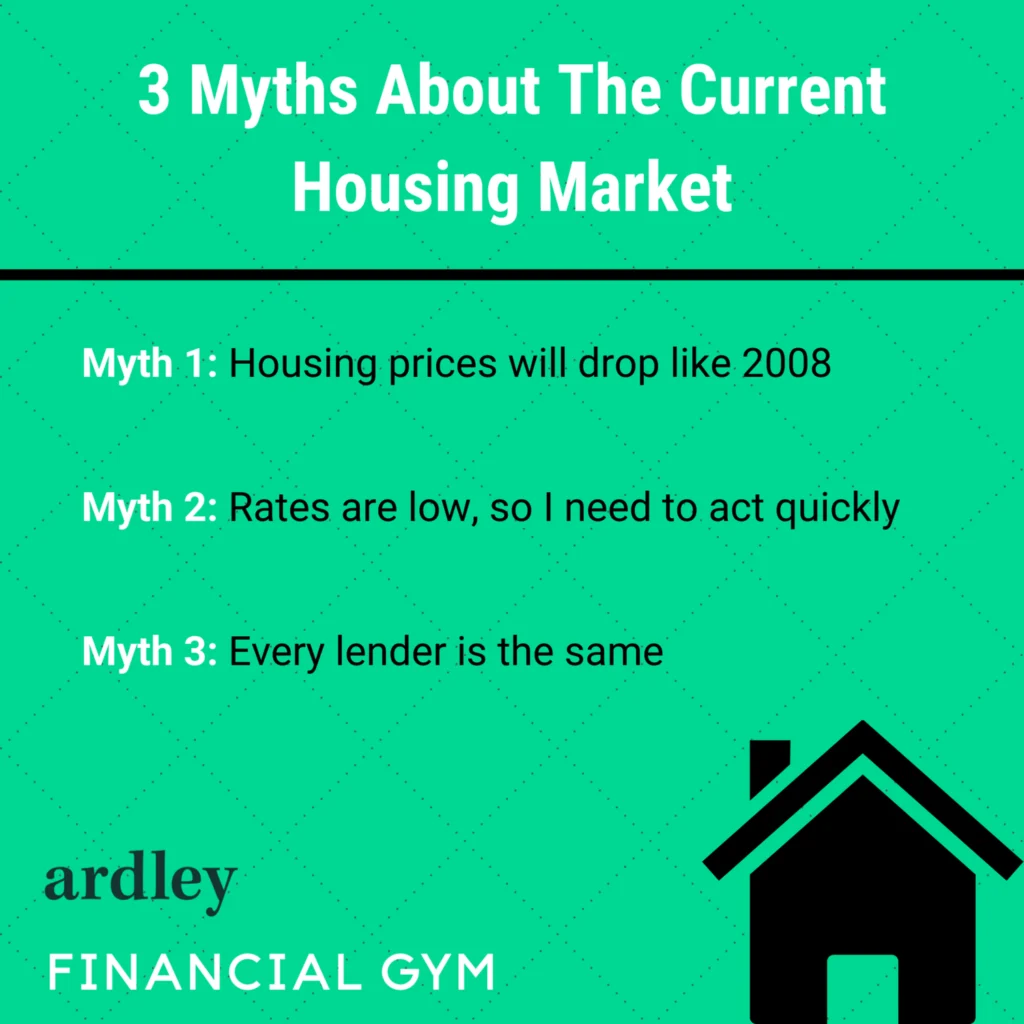
Here are a few myths about the current market and steps you can take to ensure a safe and healthy home buying experience.
Myth 1: Housing prices will drop like 2008.
This year, when the world exploded with nearly every catastrophe you could imagine, you might have expected housing prices to drop. Vice boasted the viral headline, “The Pandemic Could Be Millennials’ Best Chance to Buy a House.” Yet, housing prices have remained fairly steady and aren’t expected to fall much in the coming months.
According to a study of over 3,000 consumers this April, almost half (46%) of current renters said they would now prefer to own versus rent. The majority of those prospective buyers are younger (25-44). This is a significant jump from a first quarter report that indicated only 16% of millennials were looking to buy their first home this year. Meanwhile, mortgage applications overall have skyrocketed, interest rates dropped to historic lows, and families of all ages have chosen to upgrade or refinance. Due to a number of factors such as these listed above, housing prices are unlikely to drop much further.
The reasons that the housing market crashed in 2008 are mostly mitigated by the significant rise in mortgage regulations since that time, which safeguard mortgage applicants and homeowners from getting into loans they can’t afford. Furthermore, nearly all of the risky loan products from that era such as “interest-only” or “no doc” loans are no longer available. While nothing seems to be predictable these days, it is unlikely that the investment opportunity of a lifetime will be coming in the form of a traditional home anytime soon.
Myth 2: Rates are low, so I need to act quickly.
As previously mentioned, mortgage interest rates are at a historic low. And while a psychic medium has not been consulted on this, rates are not expected to increase in a meaningful way anytime soon, so you may not want to rush into a decision before making sure you’re ready. A small increase in rate is not worth losing some extra padding on your emergency fund that may be needed during this time.
However, if you are ready to make that leap now, you don’t necessarily have to wait for the 20% down payment. If you put less than 20% down, you will have to pay a mortgage insurance premium, but that may not be so bad during a pandemic.
On a conventional loan, when you arrive at 20% in equity on the home, you can request that the mortgage insurance premium be removed. Ideally, you could pay extra money on your principal payment each month to get to the 20% mark faster. But in a pandemic, you may prefer to keep that money more accessible. It’s a lot easier to access that cash in a bank account than in a mortgage in the event that you or someone in your family loses their jobs.
Most importantly, don’t rush into the decision. Take your time to ensure you have paid down as much consumer debt as possible (credit cards, etc.), improve your credit score if needed, and have a sufficient emergency fund (3-6 months of your expenses).
Myth 3: Every lender is the same.
As the saying goes, don’t marry the first frog you kiss. Your interest rate will likely not vary too much by lender, but their fees and overall experience can differ significantly. Ideally, you should meet with at least three lenders to review your options before making a decision.
Note: when you complete a mortgage application, the lender will do a “hard pull” on your credit, which means that it will likely make your credit score drop by a percentage or two. However, any additional applications you complete within 40 days will have no additional impact on your credit score.
Here are a few questions you will want to ask:
-
What is your timeline to close right now? Because lenders are getting such an influx in mortgage applications, many are challenged with meeting the demand. What would typically take 30 days to close could be taking 45. That may not be the worst thing, but it’s worth asking.
-
What are my estimated closing costs and interest rate? You will get an estimate of closing costs in the “Loan Estimate” they provide you after applying for the mortgage. Compare the closing costs and interest rate you get from other estimates, and you may be able to negotiate if you find a better deal.
-
Do I qualify for any down payment assistance programs? Many programs are not worth the effort or long-term commitment, but some can be very beneficial. Your lender will know if you qualify for one and will guide you in making a decision.
Lastly, ask your lender to compare loan scenarios based on your down payment. Currently, you can put as low as a 3% down payment on a conventional loan with mortgage insurance, which would allow you to lock in a low interest rate, while keeping some extra money in your bank account. However, your insurance premium decreases with a higher down payment. Compare a 20% down payment with 10%, 15% vs. 5%, etc. to see what makes the most sense for you. Remember, they get paid to do this, so don’t hesitate to ask them to work for you!
Purchasing a home is one of the most exciting financial and emotional experiences of your life, and it is usually a stable investment. But the chaos in the world can often lead us to frantic decision-making. Remember to breathe, think through your personal and financial priorities, and make the right decisions for yourself. For more information, here is a homebuyer guide we put together at Ardley that includes links to additional resources that educate you every step of your journey to buying a home.
If you have a Financial Gym Advisors trainer, they will help you walk through all of these decisions (they have for me!). And at Ardley, we are available to answer any questions you have along the way. Text us at (323) 515-8477 or visit our website to chat or set up a free video call.