Are you stuck living in the paycheck-to-paycheck cycle? It’s time to build your emergency fund. An emergency fund is money you have set aside for the emergencies that inevitably come up. Your car breaks down, you lose your job, etc. But if you have no savings getting to that first four-figures is tough. It can seem daunting even. If you’re just starting your savings journey, here’s how to save your first $1,000 for your emergency fund.
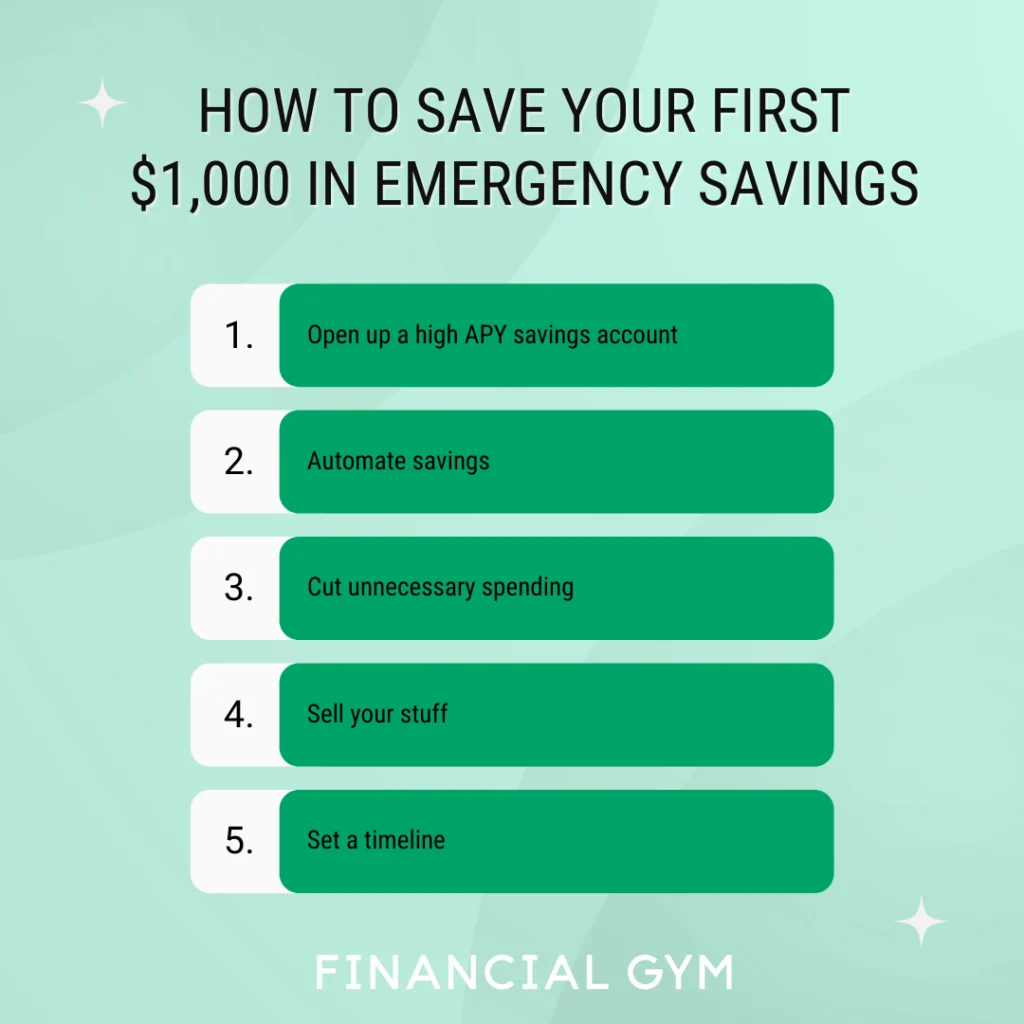
1. Open up a high APY savings account
To create an emergency fund, you need a separate savings account. It could be with your current bank or a separate bank. Sometimes it’s better to have it at a separate bank so it’s not so accessible. You can choose an online bank like Ally, Capital One or Marcus to get the best Annual Percentage Yield, so you can earn interest on your deposits.
Research your options and open up a savings account and make an initial deposit. Then, it’s time to set-up the process to build your emergency fund.
2. Automate
After opening a savings account, the next step is to automate your savings each month. Saving money is like building a muscle. You must be consistent to see progress. The unfortunate part is that our brains are good at making excuses or not following through. We also get busy and forget to do what’s good for us (that includes drinking more water!).
To take the hassle out of the process, set up automatic transfers from your checking account to your savings account. Set it up for a date after pay day so you know you have money in your account and won’t overdraft. It could be as small as $20 or up to $100 or more. Whatever you can afford each month on a regular basis, make it automatic.
Making it automatic helps build the habit without any effort and can ensure that you actually save.
3. Cut the fat
When you look at your spending, there are likely some things you can cut out. Not necessarily forever, but temporarily while you build up your emergency fund. If you’re spending $25 per week on Starbucks, maybe cut down to $5 per week and pocket that $20 per week. Limit your happy hours or cancel subscriptions that you’re not really using anymore.
You want to look at your expenses and cut the fat. That money you’re cutting out should then go straight into your emergency fund. Don’t give it a second thought or plan on spending it elsewhere! Transfer the amount you’re saving to your savings account to help reach your goals faster.
4. Sell your stuff
Have you ever looked in your closet and thought “Wow, I haven’t worn that jacket in ages?” Maybe you’ve found a gadget or something similar that you were really interested in having but the luster wore off and hasn’t really been used since. Sound familiar? It happens to the best of us.
If you bought some things that you’re not currently using, it’s time to Marie Kondo that and declutter. But don’t just get rid of stuff, sell it! Sell your items on Craigslist, Facebook Marketplace, Poshmark and Offer Up. Use that extra cash to help boost your emergency fund and get to your first four-figures.
5. Set a timeline
There’s a saying that “what gets measured, gets managed.” In order to reach a goal, you need to set a timeline and measure your progress along the way. Saving your first $1,000 can feel overwhelming when you’ve never done it. But set a goal of when you’d like to reach this milestone. For example, let’s say you want to save $1,000 within three months.
That means you need to save $333 each month. That’s $83 a week or approximately $12 per day. How can you save $12 per day every day for three months? Focus on whatever metric sounds the most digestible to you and let that inspire you to keep going and help you measure your progress. Setting a timeline helps put a fire under you and keeps you focused.
Bottom line
Saving your first $1,000 for an emergency fund is a big task. Don’t let it intimidate you! Don’t compare your journey to anyone else’s and start where you are. If you can only save $20 per month, start there. But also push yourself out of your comfort zone and know that any goal that’s worth reaching won’t be easy. Using these five steps, you can get your emergency fund set for its first big milestone.
Check our your savings account options on our B.F.F. approved high yield savings accounts page.