
Tax season always brings up a lot of questions. Should I file jointly or separately? What’s the difference between an AGI and a MAGI? Which expenses can I deduct? The last few years have thrown us a few curveballs as well, since the Tax Cuts and Jobs Act eliminated a number of exemptions, among other changes. This year, with so many employees working remotely, more confusion may arise as workers struggle to make sense of how to navigate working out of state.
Different states have different systems for regulating state income taxes. Some remote workers will pay income taxes in the state where their company does business. Others will be taxed in the state where they now reside, while others are off the hook. Some will have to file a non resident tax return in the state where they work remotely, and some will be taxed in both. Still other states have developed pandemic-specific protocols to deal with the rise in mobility of workers during this time.
According to a November survey from the AICPA, 47% of remote workers did not know that individual states have individual regulations for remote working, 71% did not know that working remotely could affect state taxes owed, and 54% did not know that their state taxes could be affected by how many days they worked in a particular state. Further research showed that a large number of remote workers has worked in more than 2 states, which could further complicate their state taxes.
Information is your first line of defense.
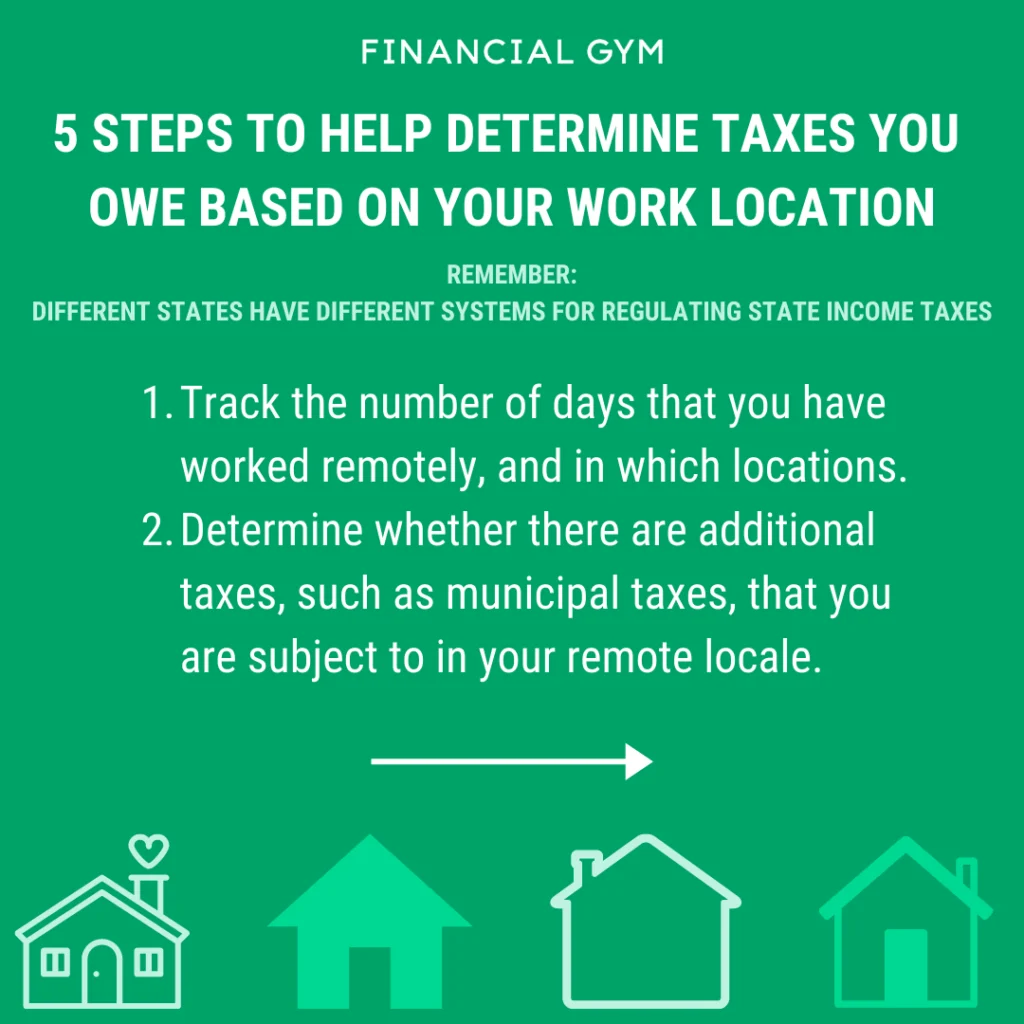
Luckily, remote workers have a bit of time to prepare. Here are 5 steps the AICPA recommends you take to make 2020 tax time go a little smoother:
-
Track the number of days that you have worked remotely, and in which locations.
-
Determine whether there are additional taxes, such as municipal taxes, that you are subject to in your remote locale.
-
Research whether the state you’re working remotely in and the state your company is in have a tax reciprocity system.
-
Check your state withholding to be sure that you don’t wind up owing at tax time.
-
Find out whether the states you’ve worked in have pandemic specific regulations governing the taxation of remote workers.
When in doubt, consult an expert.
We love DIY’ing and saving money, but if you do some research and find that your 2020 tax year is going to be as complicated as your…well, 2020, don’t take chances. Spending a few bucks on tax prep could save you money down the road and buy you some peace of mind in the interim.