
So, you invested in the stock market and made some money, congrats! Do you know how much of that gain went to Uncle Sam? That’s right, making money through investments does in fact trigger a taxable event, aka you owe taxes… it’s called the capital gains tax!
Because most brokerage platforms automatically deduct taxes for you (just like an employer might deduct taxes for their employees), you might not have even noticed that you paid a tax. And even if you did notice, the amount that was taken out might feel like a mystery!
But understanding capital gains can help you optimize the money you make in the market. Before I go any further, remember that each financial situation is different and that this article is written purely with the intent to introduce you to the concept of capital gains and not to be used as an investing or tax recommendation. Without further ado, let’s get to it.
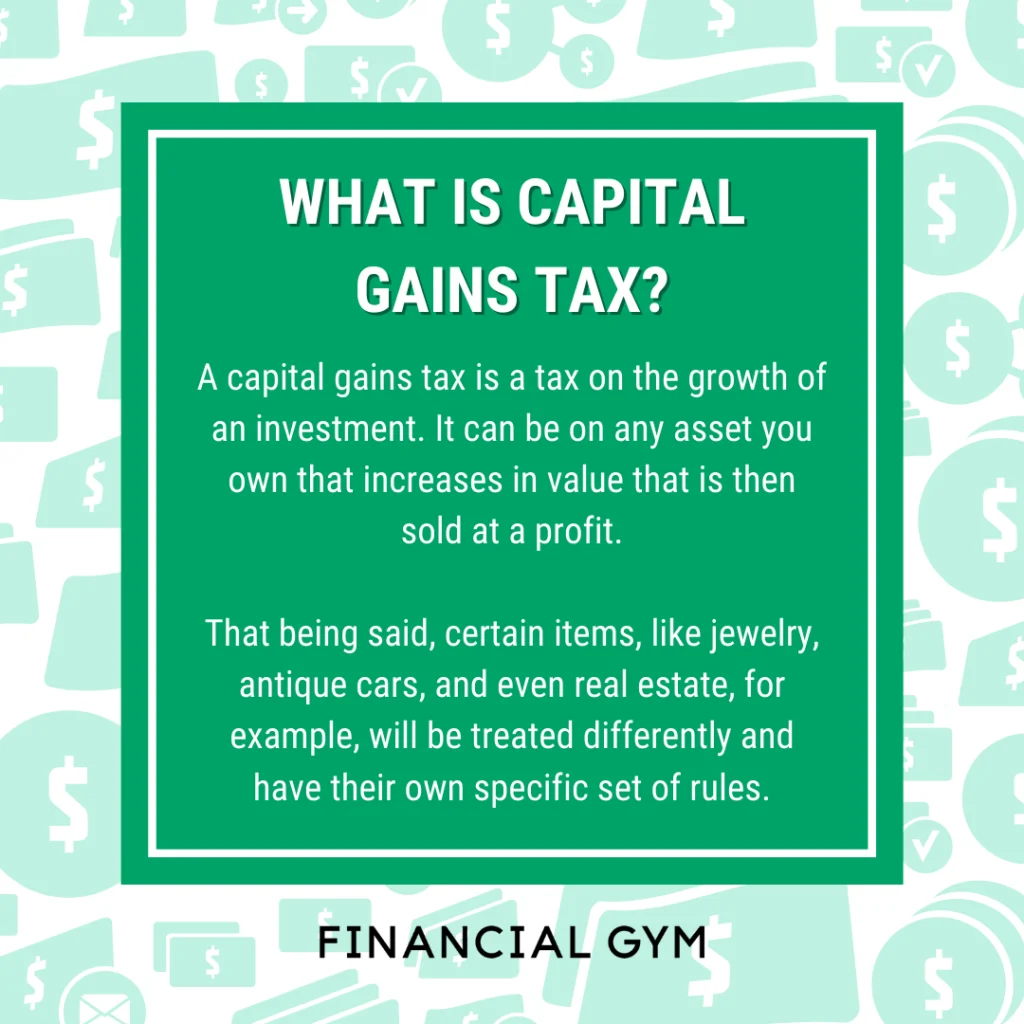
A capital gains tax is a tax on the growth of an investment. A capital gains tax can be on any asset you own that increases in value that is then sold at a profit. That being said, certain items, like jewelry, antique cars, and even real estate, for example, will be treated differently and have their own specific set of rules. For the purpose of this article, let’s focus on capital gains as they pertain to investing in the stock market.
In the stock market, you trigger capital gains tax when you sell an investment that you made money on. The tax is calculated as a percentage of the gain you earned! So if you were to invest $100 which later grew to $250 by the time you sold, you’d pay taxes on the $150 you made, but not the original $100 that you invested.
Well, that depends on two things, first, your AGI or adjusted gross income for the year, and second, how long you held your investment. Since your AGI is based on a lot of factors that you may or may not have much control over, let’s turn our attention to the latter. Depending on how long you’ve been invested, you’ll fall into one of two categories, either short-term or long-term capital gains.
Short-term capital gains tax is applied to gains that are realized within one year of the investment and will equal your ordinary income tax rate. Therefore, the rate can get pretty high!
Long-term capital gains tax, on the other hand, is applied to gains on assets that were held for at least one year. And the good news is that long-term capital gains tax comes with its own tax bracket that results in a lot fewer taxes for most people! In fact, long-term capital gains tax can even be as much as 50% cheaper than short-term. That’s the kind of savings I’m looking for.
Because tax rates and brackets change on an ongoing basis and each filing status has its own bracket, I recommend you go directly to the IRS website to find your tax rate for both short-term and long-term.
Understanding how capital gains taxes are calculated can help you optimize the money you’ve earned in the stock market. Especially when your investments are doing well, it can be really tempting to take your profits and enjoy, but patience can make a huge difference. If your financial situation affords you the flexibility to wait, and you believe in the upwards trajectory of your investment, aiming for long-term capital gains tax is often a safe bet.
Remember to do the calculations given your overall financial picture and investment strategy. As a reminder, none of this serves as a specific investing recommendation 🙂
One last side note!
Take special notice that we call this a capital gains tax because you only have to pay taxes on the money you make in the market. Therefore, you’ll never have to pay taxes on a loss!
While it may be a bummer to find out that you have to share a percentage of your investment growth with the government, remember that paying this tax means your money did grow! And that’s the goal of investing, isn’t it?