
Common is the country’s leading community based residential brand. With dozens of homes across 7 major cities, Common makes moving and city living easier than ever before for renters. Every Common co-living home comes fully furnished and move-in ready with household essentials, utilities, WiFi, and access to the Connect by Common App.
Just like finding a perfectly ripe avocado, finding quality short term housing in cities is almost an impossible task, even in “normal” times. Most apartments only offer 12 month leases, and finding housing through a friend of a friend who’s looking for a sublet isn’t exactly a quick and easy process. But, if you’re looking for short term housing right now, you’re not alone. COVID-19 and the regulations around it have disrupted many people’s plans: whether they were planning on moving to a new city for work and are now remote, or they just aren’t ready to commit to a long term lease during a time of uncertainty.
At Common, we understand your frustrations. We design and operate housing for today’s renter and are constantly trying to improve the rental process for modern living. Over the past month, we’ve been working with renters across the country to find them short term housing in our network of apartments. Keep reading for our best tips for finding and successfully moving into short term housing:
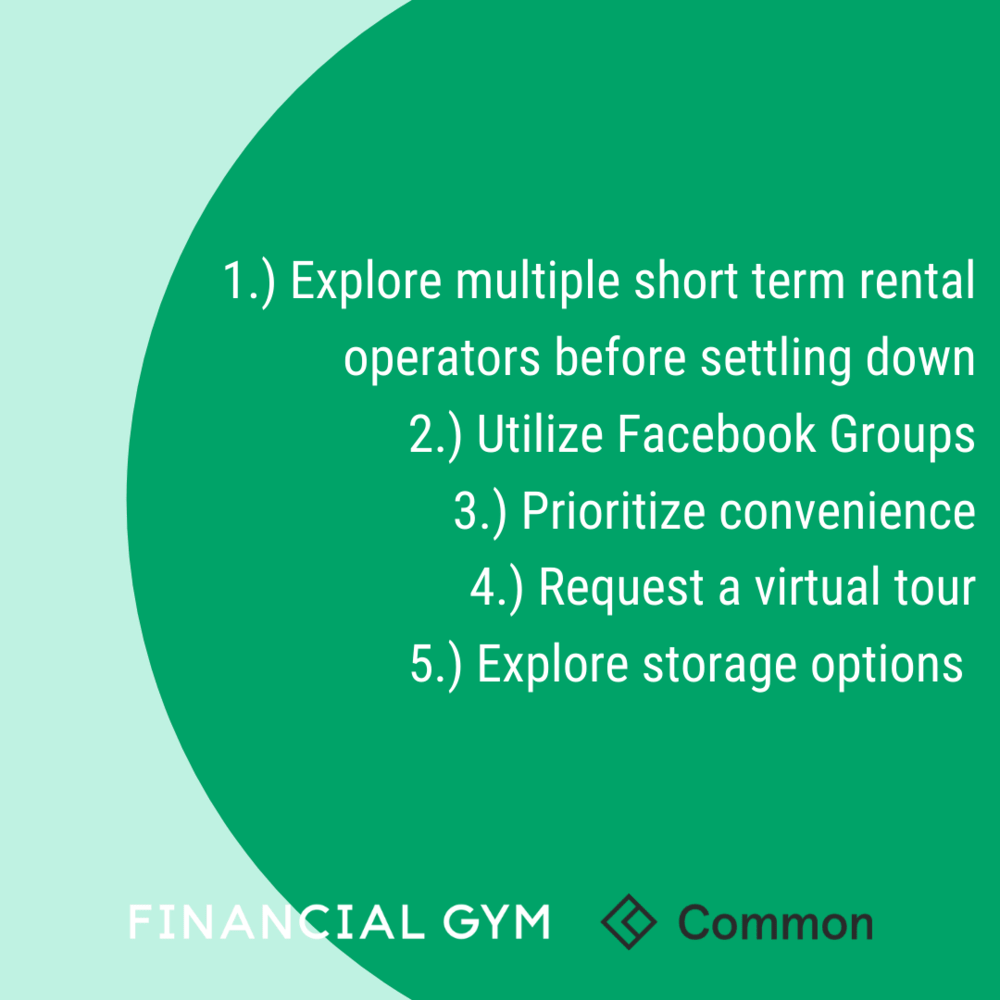
Our tips for finding and moving into short term housing:
Date a few short term rental operators before settling down. It’s important to remember that as the renter, the ball is in your court! Take time to do your research before choosing the best option for you. Many short term rental operators are offering special incentives or deals for people looking for temporary housing. While Common is not a short term rental operator, we’ve lowered our minimum lease length to two months, and have waived security deposits for anyone moving before July 1st.
Ignore Craigslist, explore Facebook groups instead. Craigslist might be the most obvious option, but Facebook groups are the secret sauce to finding short term housing in major cities. These groups are often curated by a moderator and give you the opportunity to interact directly with whomever is subletting through comments and messages. You’re also able to get a good sense of who you’re renting from right off the bat, where Craigslist is often more anonymous. One of our favorites is NYC Sublets & Apartments.
Prioritize convenience. On a typical apartment hunt, you might have a checklist that ranges from the necessary to the nice to have, and you might have the time and resources to find a space that meets every single one of your needs. However, for short term housing, finding somewhere safe, comfortable, and convenient should be your number one priority. Consider how close the apartment is to what you’ll need over the next few weeks or months. Can you walk to a grocery store or a pharmacy? What about greenspace? Do restaurants or other services deliver to your neighborhood? Once you’re able to make a longer commitment to a home, you can spend the time looking for a space with gorgeous crown molding a block away from your favorite restaurant, but for now, just focus on your needs.
Request a virtual tour. So, you’ve found an apartment and the photos look great — but how can you ensure that what you’re seeing is what you’ll actually get? Taking an in-person tour might be difficult right now as we try to maintain social distancing. That’s where virtual tours come in. Some property managers like Common offer FaceTime calls and 3D tours of available units. If you’re subletting from an individual, you can and should ask them to take you on a FaceTime tour of the space. Make sure to ask questions about storage, noise levels, and the neighborhood. If you must take an in-person tour, make sure to follow CDC guidelines on social distancing and hygiene.
Explore storage options. Moving into a fully furnished apartment is a great option if you don’t have much stuff to begin with. You won’t have to search for a comfortable couch to binge Netflix from, or worry about where to store your clothes while you wait for a dresser to arrive. But moving with an apartment’s worth of furniture and items is more of a hassle than it’s worth right now. Before you move, take inventory of everything you own. What will you need for the next few months, and what can you live without? Many storage companies are offering non-contact pickup that doesn’t require you to bring items to a storage center yourself. It might be the same price, or even lower, than renting a UHAUL, and you won’t have the additional worry or stress of unpacking everything, only to repack it a few months later.
If you have any more questions on how to find short term housing, feel free to reach out directly to the Common team at [email protected].