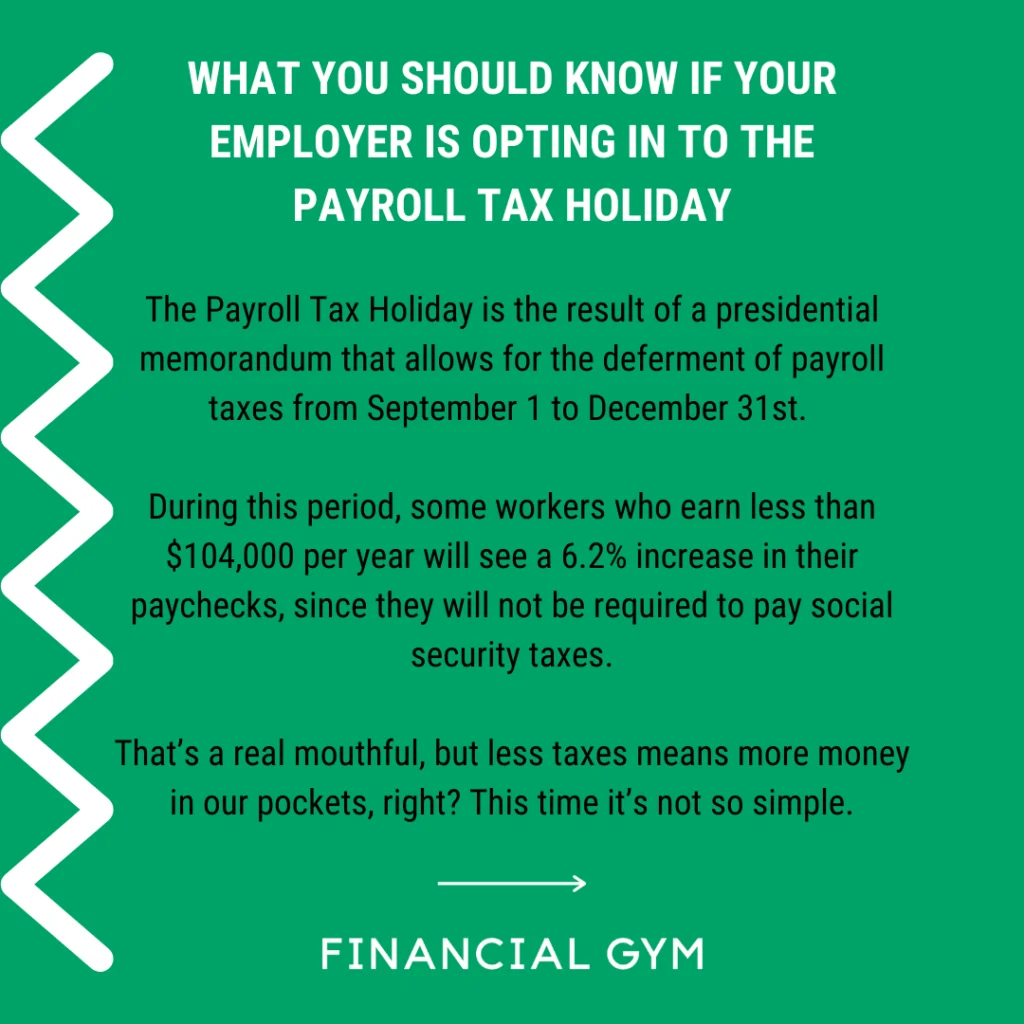
2020 has been a wild ride in too many ways to count, but last month the Payroll Tax Holiday threw us for another loop. In short, the tax holiday is the result of a presidential memorandum that allows for the deferment of payroll taxes from September 1 to December 31st. During this period, some workers who earn less than $104,000 per year will see a 6.2% increase in their paychecks, since they will not be required to pay social security taxes.
That’s a real mouthful, but less taxes means more money in our pockets, right? This time it’s not so simple.
Payroll taxes are commonly referred to as FICA taxes. FICA stands for Federal Insurance Contributions Act and these taxes are the foundation of Social Security and Medicare, two widely popular programs that help to ensure the wellbeing of the elderly, retirees, children of deceased parents, and people with disabilities. Both workers and employers pay into these programs, which are considered cornerstones of American citizens’ social safety net. Only earned wages are subject to these taxes, which means investment income like rental income and dividend income are not subject to FICA.
Employers and workers each contribute 6.2% of workers salary as a contribution to social security and 1.45% to Medicare, so a total of 12.4% and 2.9% of per salary (up to $137,000) goes into FICA. If you’re self employed, you pay both halves of the tax.
The Payroll Tax Holiday allows for the deferment of Social Security taxes, so this means that if your employer is opting into the program, and you make under the $104,000 limit, you will see a 6.2% increase in your paychecks for the 4 month period during which the program is in effect.
Your first reaction might be a happy dance. Who doesn’t like a few extra bucks in their pocket come payday? We can all find plenty of ways to put those dollars to work, whether it’s money for holiday shopping, throwing a few extra bucks into your retirement account, saving for future adventures, or padding the ever important emergency fund. Before you make too many plans for those unexpected dollars, take a closer look at the language in play.
A Deferment is not a Tax Cut
The Payroll Tax Holiday might be a lot like other holidays: at some point the good time comes to an end, and afterwards you might have a hangover.
The deferment is the result of a presidential memorandum. While the current administration has long pushed for a payroll tax cut, achieving this would require an act of congress and cannot be a result of a unilateral executive decision.
So the taxes are deferred, but they haven’t disappeared.
There is a suggestion in the memorandum that the Department of Treasury “pursue avenues” to “eliminate the obligation to pay the taxes deferred,” but there is no indication this legislation is coming down the pike. If the taxes do need to be repaid, you’ll repay by having your social security taxes doubled to 12.4% after the tax holiday ends, during the first 4 months of next year.
Tricky question. Since this is a memorandum and not an act, employers can choose to opt in or out of the program. Workers are subject to whichever decision their employer makes. Many corporations and other institutions have sat this one out because overhauling the payroll system is no easy task, and because it is unclear whether the deferment will result in the deferred taxes being forgiven. Some are also worried that they will be on the hook for employees taxes if there are more layoffs in the future. Still, many employers and federal agencies have opted in, and if that is the case for your, be sure to have a plan.
If you are a client at the Gym you’re going to recognize this familiar refrain: open a high yield savings account and each time you get paid deposit the extra money. This way you’ll earn interest on your balance and you won’t get used to having money that might not be yours. If the elusive Congressional Act comes to be, you’ll have a few extra bucks in your savings account. If it doesn’t, you will have money set aside to make up for your smaller paychecks, and you can pay yourself back.